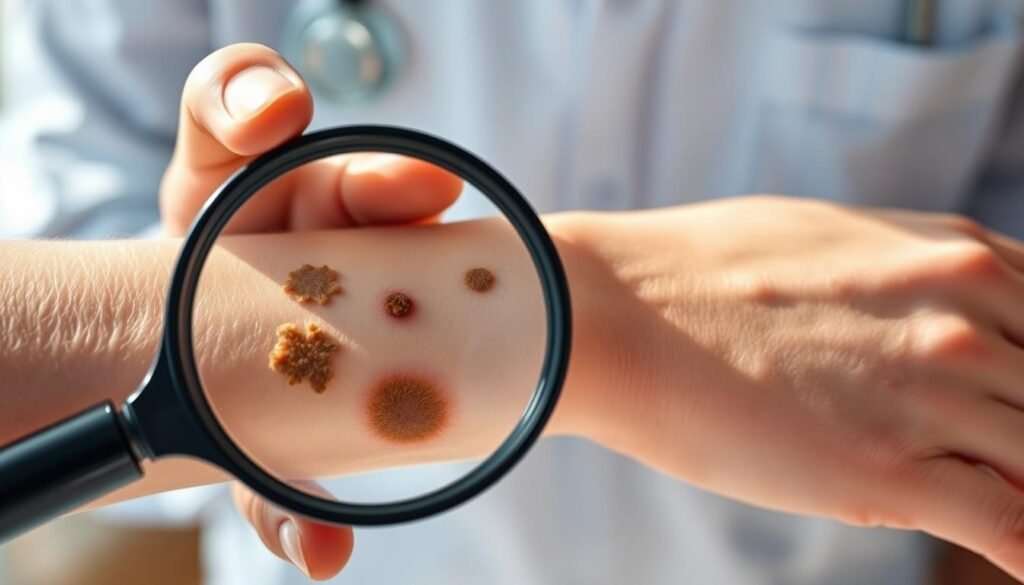
Up to 90% of visible skin aging is caused by UV exposure, says the World Health Organization. It’s key to know the difference between sun spots and age spots before starting any treatment.
This guide for skincare in the United States starts with simple steps. It helps you quickly tell sun spots from age spots. It uses advice from Mayo Clinic and St. Louis Dermatology & Cosmetic Surgery in Troy, Missouri. You’ll learn how to spot dark spots by their color, edges, and where they appear, and when to see a dermatologist.
Sun spots can appear in your 20s to 40s after too much sun. They might fade with good sun protection. Age spots get darker over time and stay longer. Both are usually harmless, but any spot that changes color, grows, bleeds, or has uneven edges should be checked by a dermatologist.
Next, we’ll talk about how UV, midday sun, and tanning beds affect spots. You’ll learn about prevention and treatments like SPF, IPL, lasers, peels, cryotherapy, and microneedling with PRP. Remember, this is for education, not medical advice. Always talk to your doctor before trying new things.
Key Takeaways
- Sun spots often appear earlier and may fade with diligent sun avoidance; age spots tend to be darker and more persistent.
- How to identify dark spots: scan for color (tan to deep brown), borders, and grouping on sun-exposed areas like the face, shoulders, and hands.
- Season, time of day, and tanning beds increase UV load, raising the chance and visibility of spots.
- Use broad-spectrum SPF 30+ daily, protective clothing, and shade to reduce new spots and prevent darkening.
- Seek care fast for spots that are black, enlarging, bleeding, irregular, or multicolored.
- Hyperpigmentation treatment options include topicals, IPL, fractional lasers, chemical peels, cryotherapy, and microneedling with PRP.
- This United States skincare guide is educational; always confirm a plan with a board-certified dermatologist.
Understanding Sun Spots and Age Spots
It’s easier to understand Sun spots vs age spots when we know what they are. Both are flat patches of color on skin that gets a lot of sun. But they appear at different times and look a bit different.
Solar lentigines often show up on the face, hands, shoulders, chest, and forearms. They become more noticeable with age and after spending a lot of time outdoors or using tanning beds. Many look for ways to make their skin color even.
What Are Sun Spots?
Sun spots are caused by UV rays and can appear at any age, mostly in the 20s to 40s. They might show up after a sunburn or intense tanning. These spots can be light to medium brown and may fade when you stay out of the sun.
They are like UV footprints on your skin. While they’re usually harmless, they remind us of the importance of protecting our skin from the sun. This is why people look for ways to get rid of them early.
What Are Age Spots?
Age spots, or Solar lentigines, are flat, round or oval, and tan to dark brown. They often appear on areas that get a lot of sunlight, like the backs of the hands and face. They tend to show up more after 40, but heavy sun exposure can make them appear sooner.
These spots show long-term changes in the skin’s pigment. As they stay, many look for gentle ways to fade them over time.
The Biological Causes
Both types are about melanin. UV rays make pigment cells work too much, creating darker patches. Over time, melanin clumps, making spots that stay on sun-exposed skin.
Tanning beds and commercial lamps increase UV exposure, making spots appear faster. People with fair skin that burns easily notice spots sooner. This shows the importance of protecting our skin from the sun every day.
| Feature | Sun Spots | Age Spots (Solar lentigines) | Helpful Notes |
|---|---|---|---|
| Typical Onset | Any age; common in 20s–40s after recent UV | More common after 40 with cumulative UV | Frequency increases with total lifetime exposure |
| Appearance | Light to medium brown; may be more diffuse | Tan to dark brown; flat, round or oval | Both are flat patches without scaling |
| Main Driver | Recent UV triggering Overactive pigment cells | Chronic UV leading to melanin clumping | UV from sunlight, tanning beds, and lamps |
| Common Sites | Face, shoulders, arms after sun-intense periods | Hands, face, chest, forearms with long-term sun | Areas regularly uncovered outdoors |
| Response to Care | May fade slightly with sun avoidance | More persistent; often need targeted care | Broad-spectrum sunscreen aids Skin discoloration remedies |
The Differences Between Sun Spots and Age Spots
Understanding the differences between sun spots and age spots is key to proper care. Both are flat, smooth marks from UV exposure. But they show different timelines in the skin. Think of age spots as long-term damage and sun spots as recent damage, guiding your dark spot removal choices.
Key Distinctions
Sun spots can appear at any age, often in your 20s to 40s, after intense or repeated sun exposure. They may lighten with steady sunscreen and shade. Age spots, on the other hand, appear more after 40 as UV damage and aging stack up, and they tend to stick around.
Age spots are usually darker and well defined. They can slowly enlarge or cluster. Sun spots look softer at the edges and may fade a bit when you limit exposure. Remember, the persistence and depth of spots affect removal results.
Visual Characteristics
Both types are flat, smooth, and painless. Age spots range from tan to deep brown, oval or round, from freckle size up to about half an inch. They appear on the face, shoulders, upper back, and the backs of hands and tops of feet. Grouping can create a mottled look.
Sun spots often share these sites but can look more diffuse, after sunburns or tanning. In color, age spots usually read darker; sun spots tend to be lighter. Knowing these differences helps you make better choices for dark spot removal that fit your skin’s history and needs.
Factors That Influence Spot Development
Dark spots form when melanin moves to the surface. Daily habits, Environmental UV exposure, and body changes affect this. Seasonal sun intensity and genes also play a part. So, Skin spot prevention techniques must fit real-life risks.

Ultraviolet (UV) Exposure
UV light makes melanocytes work faster, leading to pigment clusters. Burns or frequent tanning, including indoor beds, can cause new spots. Environmental UV exposure peaks from late morning to early afternoon. Seasonal sun intensity increases in late spring and summer.
Clouds don’t block all rays, so use SPF 30 or higher daily. Choose broad-spectrum formulas from brands like Neutrogena or La Roche-Posay. Use sunscreen with shade, hats, and UPF clothing as key Skin spot prevention techniques.
Age and Genetics
Spots appear more often after 50 as skin repairs slower. Fair skin, freckles, or a family history increase sun sensitivity. Young adults spending hours outdoors also face UV effects.
Plan for Seasonal sun intensity by setting reminders for reapplication and routine checks. Simple, steady Skin spot prevention techniques lower risk across skin tones.
Hormonal Changes
Changes in pregnancy, birth control, or midlife can affect pigment responses. UV is the main driver, but hormones make color changes more noticeable. Manage Environmental UV exposure with consistent coverage, during peak seasons.
Track patterns through the year to account for Seasonal sun intensity. Keep a basic kit—sunscreen, lip SPF, and a brimmed hat—to support practical Skin spot prevention techniques.
How to Identify Sun Spots
To spot sun spots, watch for changes after being outside. These marks can soften with less sun. Knowing their patterns helps find the right treatment.
Location on the Body
Sun spots first appear in sun-exposed areas. Look at your face, temples, and shoulders. They can also show up on your chest and hands.
They might spread across your arms and upper back after being in the sun. Tracking your sun time helps spot these marks.
Texture and Color
Sun spots feel flat and smooth. They are light to mid-brown and not sharply defined. Their edges can look a bit fuzzy.
After being in the sun, they might darken. With protection, they can fade, showing it’s time for treatment. If they grow fast or change color, see a dermatologist.
How to Identify Age Spots
Identify age spots with a simple visual check. Think about your sun time and skin tone. Then, compare what you see with the signs below. This helps when deciding between Age spot vs sun spot and choosing smart steps to Prevent age spots.
Typical Locations on the Skin
Age spots often appear where sunlight hits most. Look at the backs of the hands, tops of the feet, face, shoulders, chest, and upper back. They are more common in adults over 50, but younger people with lots of sun exposure can get them too.
Fair skin shows these marks sooner. Tracking patterns over time helps Identify age spots and sort out Age spot vs sun spot. For a full review, schedule an annual exam through this total-body skin check.
Size and Shape Variations
Most age spots are flat, oval or round, and tan to dark brown. They can be as small as freckles or up to 1/2 inch (13 mm) across. They often group together, creating a speckled, mottled look.
Unlike freckles, they do not fade when sun exposure drops. Watch for black color, rapid growth, irregular borders, mixed shades, or bleeding. These cues are important when Identifying age spots and comparing Age spot vs sun spot. They guide next steps for Preventing age spots with targeted care.
Prevention Measures for Sun Spots
Daily habits can keep pigment changes at bay. Mix smart Skin spot prevention techniques with practical Sun protection tips for steady results. This helps prevent Spot Sun Spots vs Age Spots without guesswork.

Sun Protection Strategies
Start with coverage you can trust. Wear a wide-brim hat, UV-blocking sunglasses, and long sleeves made from tightly woven fabrics with UPF 40–50. Seek shade when the sun peaks from 10 a.m. to 2 p.m., and skip tanning beds. These Sun protection tips reduce the strongest UV dose.
Time your plans with the season and setting. The UV index climbs in spring and summer, at higher altitudes, and near water, sand, or snow. Pair clothing with antioxidant support—use a vitamin C serum in the morning to help counter free radicals and bolster Skin spot prevention techniques.
- Apply strategies every day, even on cloudy mornings.
- Avoid sunburns that can trigger new spots.
- Recheck forecasts for UV spikes before outdoor activities.
Importance of Sunscreen
Choose a broad-spectrum SPF 30 or higher for head-to-toe coverage. Apply 15–30 minutes before going outside. Reapply every two hours, and after swimming or heavy sweat. This steady routine is central to Spot Sun Spots vs Age Spots prevention.
Use about a nickel-sized amount for the face and a shot-glass amount for the body. Favor mineral or chemical formulas you will wear daily. Consistent use helps prevent new marks and softens the look of recent UV-driven darkening, aligning sunscreen with proven Skin spot prevention techniques and reliable Sun protection tips.
Prevention Measures for Age Spots
Daily habits are key. Smart sun habits, regular skincare, and simple checks help prevent age spots. These steps also support sun safety in the United States without adding to your daily routine.
Skincare Regimens
Start each day with broad-spectrum SPF 30 or higher. Reapply every two hours when outside, and after swimming or sweating. This is the first step in preventing age spots and keeping results after treatments.
Use an antioxidant serum with vitamin C to combat oxidative stress. Then, apply a gentle moisturizer to protect your skin. At night, use fragrance-free cleansers and, if okayed by your dermatologist, retinol or adapalene.
After treatments like chemical peels or laser, follow your dermatologist’s maintenance plan. Stick to strict sun care and use mild, non-irritating products. These steps help maintain your skin’s color and prevent age spots.
Diet and Lifestyle Changes
Avoid tanning beds and commercial tanning lamps. Plan outdoor activities during less sunny times. Wear UPF 40–50 clothing, wide-brim hats, and wraparound sunglasses. These actions follow the best sun safety practices in the United States.
Adjust your protection based on the season and location. Use more in summer and on bright winter days with glare. Seek shade, carry a travel-size sunscreen, and log any new or changing spots to discuss with a dermatologist.
Stay hydrated, eat colorful fruits and veggies, and get enough sleep. Balanced habits support skin health and prevent age spots. Always talk to a healthcare professional before making changes to your routine.
Treatment Options for Sun Spots
Sun spots treatment combines home care with in-office procedures for clearer skin. Many start with home routines and add clinic therapies for faster results. Using sunscreen daily supports these efforts and keeps progress going.
Topical Treatments
Daily antioxidants calm sun-induced discoloration. A vitamin C serum brightens and reduces uneven patches over time. Dermatologists often add Spot removal products for better results.
Topical plans are used before and after procedures to prep and support recovery. With regular use, they help remove Dark spots and improve skin texture and glow.
Professional Procedures
Intense pulsed light (IPL) targets excess pigment without harming the skin. Fractional laser resurfacing refines texture and lifts spots, best for fair to medium tones. Chemical peels like glycolic or TCA exfoliate pigmented cells for a smoother look.
Microneedling with PRP enhances skin quality and fades marks. Clinics also offer cryotherapy and laser therapy in Sun spots treatment plans. After any service, using sunscreen and Spot removal products keeps results and prevents new spots.
Treatment Options for Age Spots
Age spots are common and usually harmless, but many people seek Dark spot removal for cosmetic reasons. Effective Hyperpigmentation treatment starts with daily sun protection to keep results and prevent new marks. Use broad-spectrum SPF 30 or higher, wear hats, and choose UV-blocking clothing. This foundation supports both at-home Skin discoloration remedies and in-office care.
Over-the-Counter Solutions
Spot removal products can fade mild discoloration when used as directed. Look for skincare with 2% niacinamide, 2% alpha arbutin, vitamin C (ascorbic acid), or retinol. Over time, these ingredients help reduce excess pigment and smooth tone. Gentle exfoliants like glycolic acid toners can boost penetration, but avoid overuse to prevent irritation.
Consumer chemical peels and microdermabrasion tools exist, yet go slow and patch test first. Pair any Hyperpigmentation treatment with moisturizer to protect the skin barrier. Persistent spots, color changes, or irregular borders should be checked by a board-certified dermatologist before cosmetic care to rule out melanoma.
Dermatological Treatments
Clinics commonly use laser and light therapies, including intense pulsed light (IPL) and fractional lasers, for targeted Dark spot removal. Dermatologists also offer chemical peels with glycolic acid or trichloroacetic acid, microneedling sometimes combined with platelet-rich plasma, prescription-strength creams like hydroquinone, and cryotherapy for stubborn lesions. Plans are tailored to skin tone, depth of pigment, and your goals.
After any procedure, follow strict sun care with SPF 30+ and protective clothing to prevent rebound pigment. Schedule routine skin checks—yearly for most adults and sooner if you have high sun exposure or a family history of skin cancer. This information is educational and not medical advice; consult a qualified professional before changing your skincare routine or starting new Skin discoloration remedies or Spot removal products.